


Dear Friends,
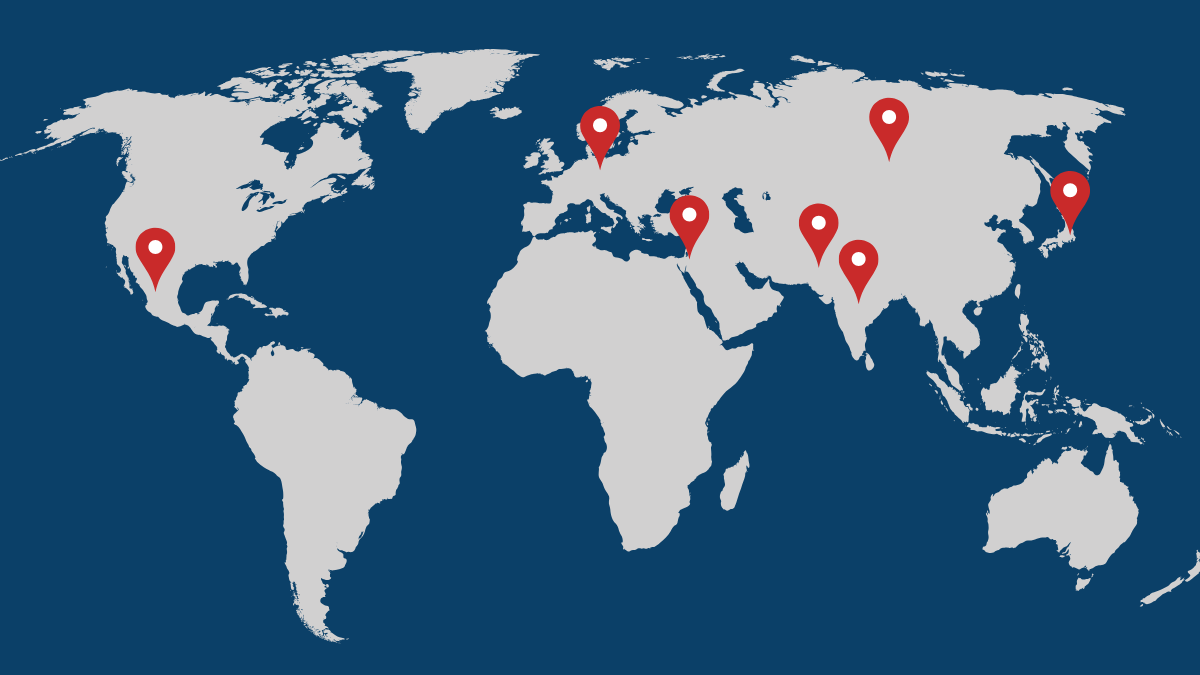
New security developments—which appear to spring up overnight—are often underpinned by growing tensions. Twin terrorist attacks within 24 hours in South Asia. Coalition governments teetering on the brink in places like Israel. Military buildups accelerating among two former WWII Axis powers. Mass protests materializing quickly in Mexico. For those of us who remember the Cold War’s relative predictability, the speed of change from simmer to boil now presents unique challenges for risk assessment and strategic planning. But as always, our team remains committed to helping you navigate these complexities with clarity and actionable intelligence.
Kind Regards,
Jack Devine
CIA Spymaster & Chairman, TAG Intel
Emerging World (Dis)Order
The India-Pakistan relationship, always fragile, is being newly challenged with terrorist violence that threatens wider regional disruption. On November 10-11, within a 24-hour span, twin terrorist attacks struck the heart of India and Pakistan, killing over 25 people and reigniting a dangerous blame game. A car bomb near Delhi’s Red Fort killed 15, followed by a suicide attack at Islamabad’s district court complex that killed 12—including lawyers and security personnel. Some officials from both governments immediately blamed the other.
Indian investigators have preliminarily linked a Kashmir-based physician to the devastating car explosion in Delhi, which Indian officials have since labeled as a terrorist attack. The suspect worked at a university in the Delhi suburb of Faridabad, where only days before Indian authorities had recovered more than 2,900 kg of explosives. The investigation is active and links between the physician and Pakistani militant groups are suspected.
Of note, as a likely unintended consequence, it’s probable that the deadly blast served to reinforce Indian Prime Minister Modi’s hardline security credentials at a pivotal electoral moment: his party secured a landslide victory on November 14 in the Bihar state elections.
On the Pakistan front, the suicide bombing in Islamabad also had a governmental twist. The attack, which was claimed by Jamaat-ul-Ahrar, a Pakistani Taliban (TTP) splinter group, targeted a governmental judicial complex. Further, the attack occurred while Pakistan was focused on rescuing 300 cadets held by militants at a military college in Waziristan, and while the Sri Lankan cricket team played nearby. Pakistan blamed India without evidence, but the more credible threat comes from the TTP’s expanding operational capacity and Islamabad’s deteriorating relationship with Afghanistan’s Taliban government.
The Risk Assessment: The India-Pakistan détente remains fragile and vulnerable to disruption by non-state actors with vested interests in maintaining regional tensions. While neither government appears to want full-scale war, the escalation ladder is short, and the nuclear backdrop makes miscalculation catastrophic. The Kashmir region and its surrounding states remain particularly volatile. I’m keeping an eye on how Pakistan responds to its internal TTP threat, particularly as the nation has done a notable job of courting Washington in recent months and doesn’t want security to challenge a more positive economic outlook.
Middle East in Flux
Israeli Prime Minister Benjamin Netanyahu faced a different kind of assault this week, one from his own government. After the United States endorsed a UN resolution supporting a pathway to Palestinian statehood as part of President Trump’s Gaza reconstruction plan, which was officially approved by the UN Security Council on Monday, Netanyahu’s far-right coalition partners issued ultimatums that threatened to topple the government.
Finance Minister Bezalel Smotrich and National Security Minister Itamar Ben-Gvir, both leaders in the settler movement, publicly demanded Netanyahu reject any discussion of Palestinian statehood, with Ben-Gvir threatening to withdraw from the coalition if the Prime Minister didn’t comply. The tensions reached a boiling point when Trump announced he was considering selling F-35 stealth fighters to Saudi Arabia as part of a normalization deal that would include a credible, irreversible and time-bound path toward Palestinian statehood.
Netanyahu issued a carefully worded statement on November 16 that was seemingly strong enough to mollify his coalition partners while sufficiently vague to avoid openly contradicting Washington or Riyadh. Defense Minister Israel Katz and Foreign Minister Gideon Saar issued similar statements against Palestinian statehood, notably, without mentioning Netanyahu.
The coalition tensions are exacerbated by a spike in West Bank settler violence that has reached levels not seen in nearly two decades. October recorded the highest number of documented settler attacks on Palestinians since 2004, including the burning of a mosque, systematic destruction of olive groves during harvest season, and assaults on rural communities. Senior IDF officers have publicly condemned the violence and called for soldiers to intervene actively against nationalist crime, and U.S. Secretary of State Marco Rubio has further warned that unchecked settler violence could undermine wider diplomatic efforts and disrupt the tenuous ceasefire in Gaza.
The Risk Assessment: Netanyahu’s coalition has stabilized a bit, but the contradictions are mounting. His government depends on far-right ministers who fundamentally oppose any path to Palestinian statehood, while his most important ally, the United States, is actively pursuing normalization deals that require exactly that pathway. Elections aren’t required until October 2026, but a far-right walkout could force earlier polls. The U.S.-Saudi F-35 deal and normalization talks represent a potential breakthrough or a coalition-ending crisis. If Saudi Arabia insists on concrete Palestinian concessions as a precondition for normalization, Netanyahu will face one of his most difficult political calculations yet.
Resource Security, Tech, and Competition
Two historical Axis powers, which both turned towards pacifism in the aftermath World War II, took major steps toward militarization this week, signaling a shift in the global security architecture. In rapid succession, Japan indicated it would defend Taiwan in the event of Chinese invasion, and Germany announced plans to create Europe’s strongest conventional army through a new military service program that brings conscription back from the grave.
Japanese Prime Minister Sanae Takaichi declared on November 8 that a Chinese military conflict over Taiwan could constitute a survival-threatening situation for Japan, which is legal language that would justify deploying Japan’s Self-Defense Forces. China’s response was swift and violent in its rhetoric, warning that Japanese intervention would be an act of aggression met with a firm response from China. But Japan’s increased defense spending and security alliances only further underscore that it isn’t going to be bullied.
Meanwhile, Germany finalized plans to build Europe’s most powerful conventional army, announcing a new military service model that will increase the Bundeswehr from 182,000 troops to 260,000 within a decade, supported by 200,000 reservists. Starting January 1, 2026, all 18-year-old German men must complete a questionnaire on their military suitability, and from July 2027, undergo mandatory medical screening. Women can volunteer. If recruitment targets aren’t met through voluntary service, the Bundestag can authorize compulsory conscription bringing back the draft that was suspended in 2011.
The Risk Assessment: The rearmament of Germany and Japan represents a fundamental realignment of the global security order. For 80 years, these nations have been security consumers, relying on the U.S. nuclear umbrella and alliances for protection while maintaining minimal military capabilities. That era appears to be ending. Both countries are looking to become security producers, capable of defending their interests and allies without complete dependence on American support. Further, the risk of miscalculation in the Taiwan Strait has never been higher and Russia is increasingly pushing threatening European nations outside of Ukraine’s boundaries. Unlike in previous decades, however, both Japan and Germany are now signaling they won’t remain on the sidelines.
We help organizations understand how cartel dynamics intersect with political risk, and give clients real-time insight into escalating unrest and government reactions. Explore our services.
Weekly Wildcard
On November 15, thousands of protesters—many identifying with Generation Z but joined by supporters of all ages—descended on Mexico City’s Zócalo to denounce what they called a “narco-government” and demand President Claudia Sheinbaum take stronger action against organized crime. What began as peaceful marches ended with violent clashes and by the end of the day, 100 police officers were injured and 20 civilians were wounded, with 20 arrests made.
The catalyst was the November 1 assassination of Uruapan Mayor Carlos Manzo, who had led an aggressive anti-cartel campaign in Michoacán state. Manzo was shot seven times at a public Day of the Dead event after publicly criticizing Sheinbaum in September. His death became a rallying point for a movement that accuses the government of maintaining a “pact” with narcos.
Sheinbaum, who took office in October 2024 with approval ratings above 70%, quickly accused right-wing opposition parties of infiltrating the Gen Z movement and using social media bots to inflate attendance. Some social media influencers who initially supported the protests backed away after government pressure. But the crowds that appeared on Saturday seemingly represented a genuine cross-section of Mexican society. Protesters wore straw hats symbolizing Manzo’s political movement.
As we’ve been tracking at TAG Intel, these Gen Z protests are part of a global pattern of mobilization against perceived government failure. For instance, similar youth-led uprisings this year have toppled governments in Nepal, following social media bans and corruption scandals, and Madagascar, after prolonged water and electricity shortages exposed systemic failures. The difference in Mexico is the specific focus on cartel violence and state complicity. And this is a dangerous arena for public protest in a country where mayors, journalists, and activists are routinely assassinated for challenging organized crime.
The Risk Assessment: For companies operating in or near sanctioned jurisdictions, the implications are profound. Compliance departments should assume that sanctions enforcement will remain aggressive and that the net will continue to widen. The era of “We didn’t technically violate the letter of the sanctions” as a viable defense strategy is over. Treasury’s Office of Foreign Assets Control (OFAC) and its counterparts in Europe are getting more sophisticated about identifying sanctions evasion networks, and they’re increasingly willing to designate facilitators even when the connection isn’t obvious.