


Dear Friends,
What a government chooses not to do can be as meaningful as what it does. When Secretary of State Rubio boards a plane to Canada for the G7 but the administration boycotts the G20 in Johannesburg and skips COP30 in Brazil entirely, that’s not simply calendar management, it’s strategic signaling. When a former jihadist with a $10 million bounty on his head walks into the Oval Office for the first-ever visit by a Syrian head of state to the White House, that’s a deliberate message about realignment in the Middle East. And when Trump rolls out the red carpet for five Central Asian presidents, it’s about more than diplomatic niceties. Washington is making selective bets on partnerships that serve immediate economic and security interests while openly disengaging from multilateral forums it views as either ineffective or hostile to American priorities. Whether that proves wise in the long run remains to be seen, but the paradigm is rapidly shifting.
Kind Regards,
Jack Devine
CIA Spymaster & Chairman, TAG Intel
Emerging World (Dis)Order
This week offered a revealing contrast in American diplomatic engagement. Secretary of State Marco Rubio spent Tuesday and Wednesday in Niagara, Ontario, attending the G7 Foreign Ministers’ Meeting—discussing President Trump’s peace initiatives in Ukraine and Gaza, maritime security, supply chain resilience, and critical minerals with counterparts from France, Germany, Italy, Japan, and Britain. The State Department emphasized that foreign ministers will build on commitments made at the G7 Leaders’ Summit in Kananaskis, Canada earlier this year.
Meanwhile, Trump announced emphatically that no U.S. government officials will attend the G20 summit in Johannesburg on November 22-23. South Africa’s foreign ministry called the decision regrettable. The real friction runs deeper than a bilateral disagreement: Trump has taken issue with South Africa’s case accusing Israel of genocide in Gaza, its new BRICS membership, and what he views as the G20’s problematic theme of solidarity, equality and sustainability—which Rubio earlier dismissed as DEI and climate change.
The U.S. absence from COP30 in Brazil is equally deliberate. The White House confirmed it will send no high-level representatives to the UN climate conference running November 10-21 in Belém. Energy Secretary Chris Wright went further, calling COP30 essentially a hoax during remarks in Athens. White House spokesperson Taylor Rogers explained that President Trump will not jeopardize U.S. economic and national security to pursue vague climate goals that are killing other countries.
The Risk Assessment: Trump is prioritizing forums where he can advance tangible security and economic deals while openly rejecting multilateral gatherings he views as either ineffective talking shops or ideologically opposed to American interests. The G20 boycott is particularly significant as China’s President Xi Jinping and European leaders will all still attend, potentially allowing Beijing to expand influence among developing economies. Only projects directly aligned with Trump’s stated priorities—energy partnerships, critical mineral development, Middle East peace—will likely receive policy tailwinds and possibly direct government support. Conversely, climate-focused initiatives relying on international frameworks, development programs in countries Trump views as hostile, and multilateral governance forums, should anticipate policy headwinds and reduced U.S. participation.
Middle East in Flux
On Monday, Syrian President Ahmed al-Sharaa made history as the first Syrian head of state ever to visit the White House. It’s impossible to overstate how extraordinary this moment is—and not simply because it’s unprecedented. Less than a year ago, al-Sharaa had a $10 million U.S. bounty on his head as the former leader of Hayat Tahrir al-Sham, an Al-Qaeda offshoot. Two decades earlier, as a young man in his twenties, he joined Islamist insurgents battling American forces in Iraq and was captured and detained at Abu Ghraib.
Yet on Monday, President Trump welcomed him warmly in the Oval Office, describing their relationship as productive. The administration lifted al-Sharaa’s terrorist designation just three days before the visit and announced Monday that Syria will join the U.S.-led Global Coalition to Defeat ISIS.
This isn’t the first time Trump has praised al-Sharaa. They first met in May in Saudi Arabia, when Trump ordered the lifting of some sanctions on Syria as per Saudi’s request. But the symbolism of Al-Sharaa’s D.C. visit, where he even played basketball with members of the U.S. military, is profound. Al-Sharaa’s 20-country diplomatic tour since seizing power from Syria’s longstanding leader Bashar al-Assad in December demonstrates his determined pivot from revolutionary to statesman. Syria’s foreign minister called the visit a major turning point that opens a new chapter in U.S.-Syria relations.
To find a comparable precedent, we can look back to Yasser Arafat’s White House visits in the 1990s—another former militant leader the U.S. once considered a terrorist but eventually decided it needed to negotiate with. The parallel is instructive: Washington has concluded that engaging al-Sharaa serves American interests better than isolating him, particularly as Syria breaks from its decades-long alignment with Russia and Iran. During his UN General Assembly address in September, al-Sharaa emphasized Syria’s commitment to reclaiming its rightful place among the nations of the world.
The Risk Assessment: This rapprochement creates both opportunities and risks. Syria desperately needs reconstruction investment, and the lifting of sanctions could eventually open significant business opportunities in a strategic location, but its domestic situation remains precarious. Al-Sharaa faces ISIS remnants, an assertive Israel, Russia’s determination to maintain its strategic foothold while harboring Assad, and deep divisions among its ethnic and religious communities. Flashes of violence are frequent. While these risks are being assessed by businesses, on the geopolitical front Trump is signaling that pragmatic engagement with reformed adversaries—even those with deeply problematic pasts—takes precedence over ideological purity when it serves American interests.
Resource Security, Tech, and Competition
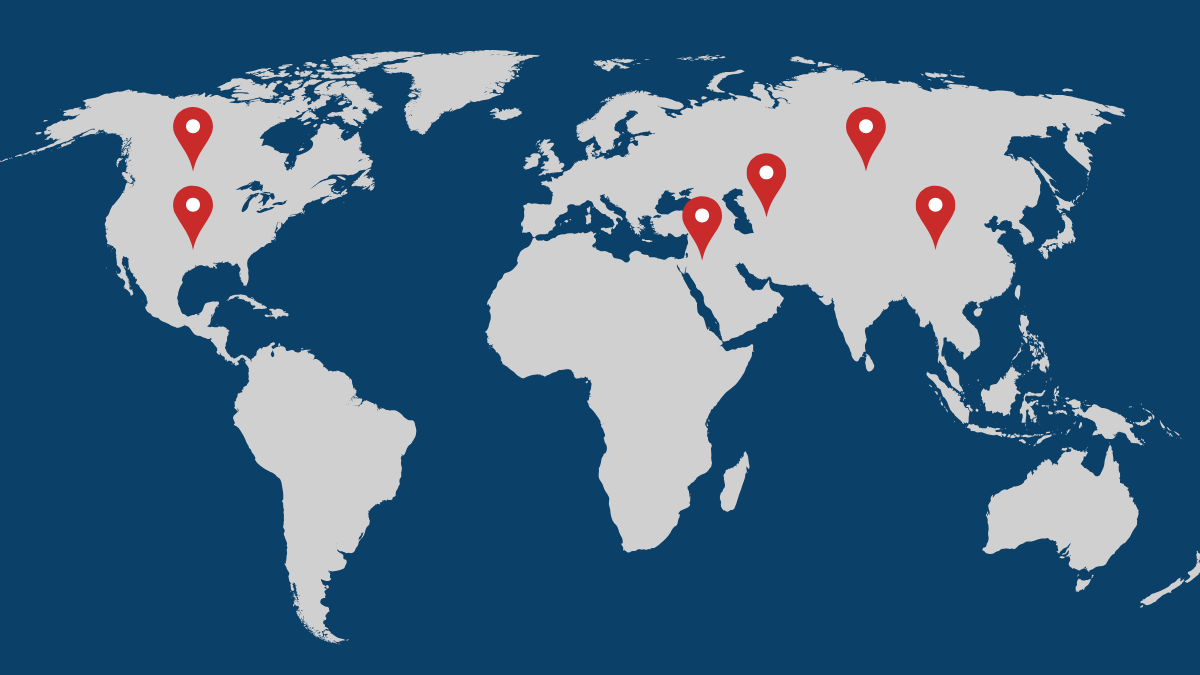
Late last week, President Trump hosted an elaborate White House dinner for the leaders of five Central Asian nations—Kazakhstan, Kyrgyzstan, Tajikistan, Turkmenistan, and Uzbekistan (C5)—in what marked only the second time a sitting U.S. president has participated in a C5+1 summit at the presidential level. The gathering was ostensibly to mark the 10th anniversary of the C5+1 diplomatic format launched in 2015, but the real agenda was how to secure U.S. access to Central Asia’s critical minerals and rare earths.
Central Asia’s critical mineral exports have historically tilted overwhelmingly toward China and Russia. In 2023, Kazakhstan sent $3.07 billion in critical minerals to China and $1.8 billion to Russia, compared with just $544 million to the United States. But Trump has been working the region aggressively. In September, Uzbekistan’s President Mirziyoyev signed agreements with Washington worth billions and in October, Kazakhstan inked a $4.2 billion deal with U.S. locomotive manufacturer Wabtec. A bipartisan Senate group introduced legislation to repeal Soviet-era Jackson-Vanik trade restrictions that lawmakers say impede American investment in these former Soviet republics.
The Russian and Chinese reactions haven’t been subtle. In June, Chinese President Xi Jinping attended C5 talks in Kazakhstan to boost Belt and Road Initiative involvement. Last month, Russian President Putin joined a C5 summit in Tajikistan to strengthen military cooperation. Pro-Russian media outlets have derided the Central Asian leaders’ engagement with Trump, framing it as betrayal of traditional partnerships. And the European Union has also entered the fray, inking a strategic partnership in Uzbekistan in April with an investment program potentially worth $13.8 billion.
The Risk Assessment: Trump is attempting to reorient decades of Central Asian trade relationships, and he’s using America’s enormous market access and capital resources as leverage. For mining companies, equipment manufacturers, infrastructure developers, and logistics providers, Central Asia represents opportunities but only if they’re comfortable with the political and security complexities of operating in a great power competition zone. The Central Asian governments are likewise playing a delicate game, maximizing U.S. investment and technology access while avoiding actions that would provoke Russian military intervention or Chinese economic retaliation. But Kazakhstan’s recent announcement that it would be joining the Abraham Accords was a major symbolic win for Washington and a clear signal to Moscow and Beijing about where Astana, and potentially the larger neighborhood, sees its future interests aligning..
Weekly Wildcard
One of the most persistent criticisms of economic sanctions is that they don’t work—that determined actors find workarounds, that secondary markets develop, that authoritarian regimes simply absorb the pain and pass costs to their populations. This week provided compelling evidence that well-designed, aggressively enforced sanctions can indeed bite, particularly when targeting chokepoints in global financial and logistical systems.
Consider the unraveling of Russian oil giant Lukoil’s international assets. Following intensified U.S. sanctions pressure and coordination with European partners, multiple countries have moved to seize or freeze Lukoil assets within their jurisdictions. European nations, concerned about secondary sanctions exposure and reputational risk, have begun nationalizing or freezing Lukoil holdings in refineries, distribution networks, and retail operations. The pattern is revealing: even in countries historically reluctant to directly confront Russian economic interests, the combination of U.S. sanctions designations and the threat of being cut off from dollar-denominated transactions is proving decisive.
The sanctions architecture has evolved significantly since the invasion of Ukraine. Rather than broad sectoral measures that create humanitarian concerns and generate international blowback, current approaches target specific entities, individuals, and transaction networks with precision. The goal isn’t to collapse the Russian economy wholesale, it’s to systematically degrade Russia’s ability to generate revenue from energy exports and to increase the costs of sanctions evasion to levels that deter participation.
Ukraine’s aggressive campaign of drone strikes against Russian oil infrastructure provides the kinetic complement to economic pressure. Over recent months, Ukrainian forces have conducted systematic attacks on oil depots, refineries, and export terminals within Russia, most notably halting fuel exports at Tuapse Port on the Black Sea. These are strategic operations designed to degrade Russia’s ability to generate revenue and supply its military machine. The cumulative effect of economic sanctions and physical infrastructure disruption is evident in Russia’s energy export data, which shows declining volumes and prices even as global energy demand remains robust.
The Risk Assessment: For companies operating in or near sanctioned jurisdictions, the implications are profound. Compliance departments should assume that sanctions enforcement will remain aggressive and that the net will continue to widen. The era of “We didn’t technically violate the letter of the sanctions” as a viable defense strategy is over. Treasury’s Office of Foreign Assets Control (OFAC) and its counterparts in Europe are getting more sophisticated about identifying sanctions evasion networks, and they’re increasingly willing to designate facilitators even when the connection isn’t obvious.
For clients, the evolution of sanctions—from broad strokes to precision financial targeting—demands a new level of due diligence and compliance rigor. Explore our offerings to see how we can help your company to anticipate, and avoid exposure before enforcement reaches them.